
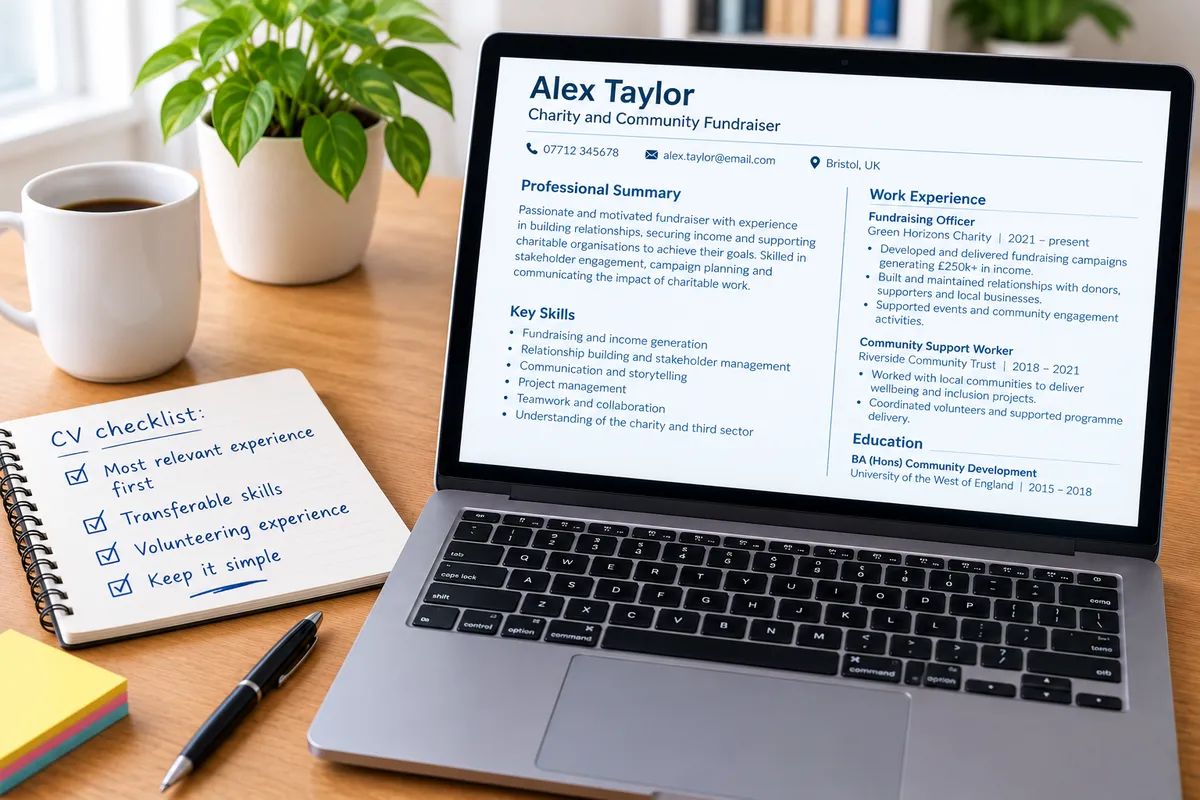
If you're applying for a charity job, your CV should be tailored to the role you're applying for. Charities are looking for people with the right experience, but they're also looking for people who understand their cause, their beneficiaries and the realities of working in the third sector.
That doesn't mean you need to completely rewrite your CV for every job you apply for, but you do need to make sure that it is clear why your experience is relevant, what you can bring to the organisation, and why you want to work in that particular role.
Here is a quick guide on how to write a CV for a charity job that gets the important information across quickly. You can also make use of our CV review service where we help you re-write your CV so it is ready for your next application.
1. Start with the job description
Before you change anything on your CV, read the job description for the role you are applying for properly.
It sounds obvious, but this is one of the easiest things to skip when you're applying for several jobs. Start by looking at what the organisation is actually asking for. What experience do they mention? What skills are essential and desirable? Are there particular areas of knowledge they want?
For example, if a charity is looking for a Fundraiser, they will want your CV to mention things such as:
Trusts and foundations
Corporate fundraising
Individual giving
Events
Bid writing
Managing fundraising targets
This is important. Your CV should make it easy for the person reading it to see which of these things you have experience in. Make it clear that you meet the criteria. This doesn't mean copying the job description word for word. It means making sure your relevant experience is clear and isn't hidden away in lots of text.
2. Put your most relevant experience first
Your CV doesn't have to tell the complete story of your working life. If you've worked across a few different sectors, think about which parts of your previous experience are most relevant to the charity role you're applying for.
For example, you might not have worked for a charity before, but you could have:
Managed projects
Built relationships with stakeholders
Worked with volunteers
Managed budgets
Written funding applications
Organised events
Managed social media
Worked directly with customers or service users
Don't assume that experience only counts if it happened inside a charity. A lot of skills will transfer between sectors, and your job is to make that connection clear.
3. Don't overlook transferable skills
If you're moving into the charity sector, you might be worried that you don't have enough relevant experience. You might have more than you think. A charity might need someone who can manage a project, write clearly, build relationships, manage a budget or communicate with different audiences. Those skills aren't exclusive to the third sector.
For example, experience in sales could demonstrate relationship building and meeting targets. Experience in the public sector could demonstrate stakeholder management, policy knowledge or working within complex organisations. The important thing is to explain the relevance rather than expecting the hiring manager to work it out for themselves.
This is where your CV comes in. Think back to your previous roles. You can even look at your previous job descriptions and identify the skills you demonstrated or developed in those roles. You don't need to have worked for a charity to have relevant experience.
4. Show that you understand the charity
This might be something you include in your cover letter, or it might be something you add to your personal statement. But it's important to show that you understand the organisation and the work it does. This is one of the things that can help your application stand out. It shows that you've taken the time to understand where you're applying, rather than sending the same application to every charity.
Charities are often looking for people who care about what they do, but simply writing “I'm passionate about XYZ” doesn't tell them much. Instead, show that you've taken the time to understand the organisation, including its challenges, what it's trying to achieve and what you could bring to the role. This is where values-based CV writing can be useful. Rather than simply saying that you care about a particular cause, use your experience to show how your skills, experience and values align with the organisation and the role.
If you're writing a personal statement, you might use this opportunity to go into more detail about why this particular type of work interests you. If you've volunteered, fundraised or worked with an organisation in a similar area, mention it.
It's also important not to force a personal connection if there isn't one. A genuine interest in an organisation is much more useful than a paragraph full of generic statements about how passionate you are.
5. Check the basics before you apply
It's easy to spend hours changing the content of your CV and then miss a spelling mistake in the first paragraph.
Before you submit it, check:
Is the organisation's name correct?
Have you included the most relevant experience?
Do your dates match?
Are there any spelling or grammar mistakes?
Are your contact details correct?
Have you followed any application instructions?
Does the file open correctly?
Is the CV easy to read on screen?
And if you've tailored your CV for the role, make sure you've actually saved the correct version before uploading it. It sounds simple, but getting the basics right matters.
6. Keep the format simple
You don't need an elaborate third sector CV template. In fact, a simple layout is usually a lot easier to read. Make sure that your CV has clear sections, consistent formatting and enough white space. Use headings that make sense and keep your employment history in reverse chronological order.
A typical charity CV might include:
Personal profile
Key skills
Employment history
Volunteering experience
Education and qualifications
Additional information, where relevant
You don't need to include every section if it doesn't add anything. And don't make your CV difficult to scan just because you want it to look different. Good design should make the information easier to find, not get in the way of it.
7. Include volunteering and community experience
If you've volunteered, don't automatically put it at the bottom of your CV as an afterthought. Volunteering can demonstrate relevant experience, particularly if you're moving into the charity sector or applying for your first charity role.
Think about what you actually did.
“Volunteer at local food bank” is useful, but:
“Volunteered weekly at a local food bank, supporting distribution to around 100 households and helping coordinate new volunteers” gives a much clearer picture.
The same applies to trustee roles, community projects, fundraising challenges, committee positions and other unpaid work. If you've developed useful skills through it, it belongs on your CV. Remember you can also find volunteering opportunities at Get Jobs.
8. Don't make your CV too long
More information doesn't automatically make a stronger CV. If you've been working for 20 years, you don't necessarily need three pages explaining every responsibility you've ever had. Focus on what's relevant to the role you're applying for.
Older experience can be summarised, particularly if it doesn't relate to the job. The person reading your CV should be able to quickly understand:
What do you do?
What have you done?
What can you bring to this role?
If they have to dig through several pages to find the answer, your CV probably needs some editing. Your CV doesn't need to include everything you've ever done. It needs to include the things that help show why you're a good fit for this particular role.
Your CV doesn't need to tell your whole working history. It needs to make it clear why your experience is relevant to the role and what you could bring to the organisation. Take the time to tailor it, check the basics and make sure the most relevant information is easy to find.
